Tuesday, October 2, 2012

C is for COW

Cows are a signal of wealth and pride in Rwanda. Bridal dowries are paid in the form of cows. Mpa inka! literally translated means “Give me a cow!” and is a common expression used to show surprise or disbelief. Visit any Rwandan at her home and she will likely offer you a large mug of warm milk (often accompanied with an excessive amount of sugar). Traditional Rwandan dance involves raising your arms and hands and swaying them, like the large horns of precious Rwandan cows.


"Cow callers" sing to the cows presented at a bride's
dowry ceremony
The Rwandan government has initiated a “one cow per family” program, which aims to provide poor families in Rwanda with cows. Villagers meet together to vote on which family is most in need of support, and later provides them with a cow. Once this cow has given birth, the recipient family will return the calf to the village so it can be given to another poor family. All the while, the cow’s milk and manure can provide nutrition, fertilizer, and/or income for the family, as well as generally elevating their social status.

When I first heard about this program I thought it was ridiculous. Just give a cow away?! If you have read any other posts on this blog, you know how I feel about this sort of charity. Early in my service, when I visited the home of two malnourished siblings and found their father drinking sorghum beer, feeding an enormous government-donated cow while his children cried with hunger, I felt my skepticism was vindicated. Months later I found the man had sold the cow and spent all the money on alcohol.

Experts also warn about the dangers of these types of aid programs. The well known charity Send a Cow works around the developing world (Rwanda included) giving poor people, women in particular, cows and other farm animals like sheep and goats. In the developed world, they market their fundraising campaigns around the idea that when you buy a family a cow, you are providing them an opportunity for a new life, animals being such a good source of income in most developing countries.

There are numerous problems with this model. Send a Cow in particular, has received criticism several times for the amount of money they actually spend on donated farm animals versus their European office and administrative costs. More importantly, however, cows don’t just magically produce nutritious, income generating milk. They also consume an enormous amount of food. In the most densely populated country in Africa, you can imagine how taxing it is for farmers and families to decide between using their scarce land to plant food for themselves or their cows. In case you’re wondering, it’s often the cow that is prioritized.

Environmentalists worldwide have come out against this animal giving charity scheme. Conservationists at the World Land Trust have referred to these projects as “environmentally unsound and economically disastrous”. Scientists are also warning, world food shortages and the impact of animal grazing on water supply and farming is alarming. 

So, why the ruinous program to provide everyone with a cow? The cooperative nature of the scheme forces Rwandans of all ethnic backgrounds to work together for the sake of community development. If you look further back in Rwandan history, you can understand even more.

Traditionally, the minority Tutsi ethnic group (persecuted and indiscriminately slaughtered in the 1994 genocide and in several previous attacks dating as far back as the 1962 independence), were cow herders. Many were Rwandan royalty and considered much superior to their neighbors, the majority Hutu ethnic group, who were poor land farmers. While attending a Genocide remembrance ceremony last year, a survivor retold the audience how groups of interahamwe came through the villages, stealing all the cows of the Tutsi they were about to kill. I was surprised by the emphasis he placed on the loss of cows while retelling a story about the death of almost a million people.

So, in my very non-expert opinion, I think I understand how, when the Tutsi-born President tells his countrymen (the majority of which remain poor, rural farmers, and are descendants of Hutus), that they should all have the opportunity to own cows, the positive symbolism and good will, in this case, might outweigh the negative environmental and agricultural effects.  

Monday, October 1, 2012

B is for BABY

Meet Baby, my delightful neighbor. Baby is the third child of my neighbor Assumpta, a nurse at the hospital who recently opened a small shop in town. Baby’s real name is Ingrid (her older sister is Igette and her older brother Ig), but in the year and a half I’ve lived next to her, I’ve only ever heard people call her Baby.

I really don’t have words for the love I feel for Baby. When I first moved in, Baby was just a baby. She could barely crawl and spent most of her time wrapped in a cloth on her mother’s back. Today she is an energetic toddler who runs up and down the small sidewalk that connects my house to hers: squealing, laughing, and proudly chanting the few words she’s just started speaking.

I take back anything negative I ever said about studying child development—it’s fascinating. Each month Baby seems to take on a new personality. From shy dependant infant to curious and active toddler, she never ceases to amaze me.

In the evenings, when I come home exhausted from a long day of work, Baby acts like a ray of warm sunlight, replacing the real sun that’s already disappeared behind the hills, leaving my house cold. She runs towards me, arms stretched out, sometimes squealing, sometimes just smiling. Then, she generally proceeds to parade around my house, which I am sure she does just to show off. If there are other children around, she taunts them as she walks through the door, knowing she’s the only kid I will allow inside. After inspecting my quarters, Baby attempts to help me with my dishes, inevitably ending up soaked in water. Next, she follows me around while I cook. By the time the fire is ready, I gently nudge her back to her home, at which point she cries hysterically. 

In a country where warm affection is rarely shown, I feel a mix of pain and happiness when I hear the Baby crying because we’re parting for the night.

Sunday, September 30, 2012

A is for AGATOGO

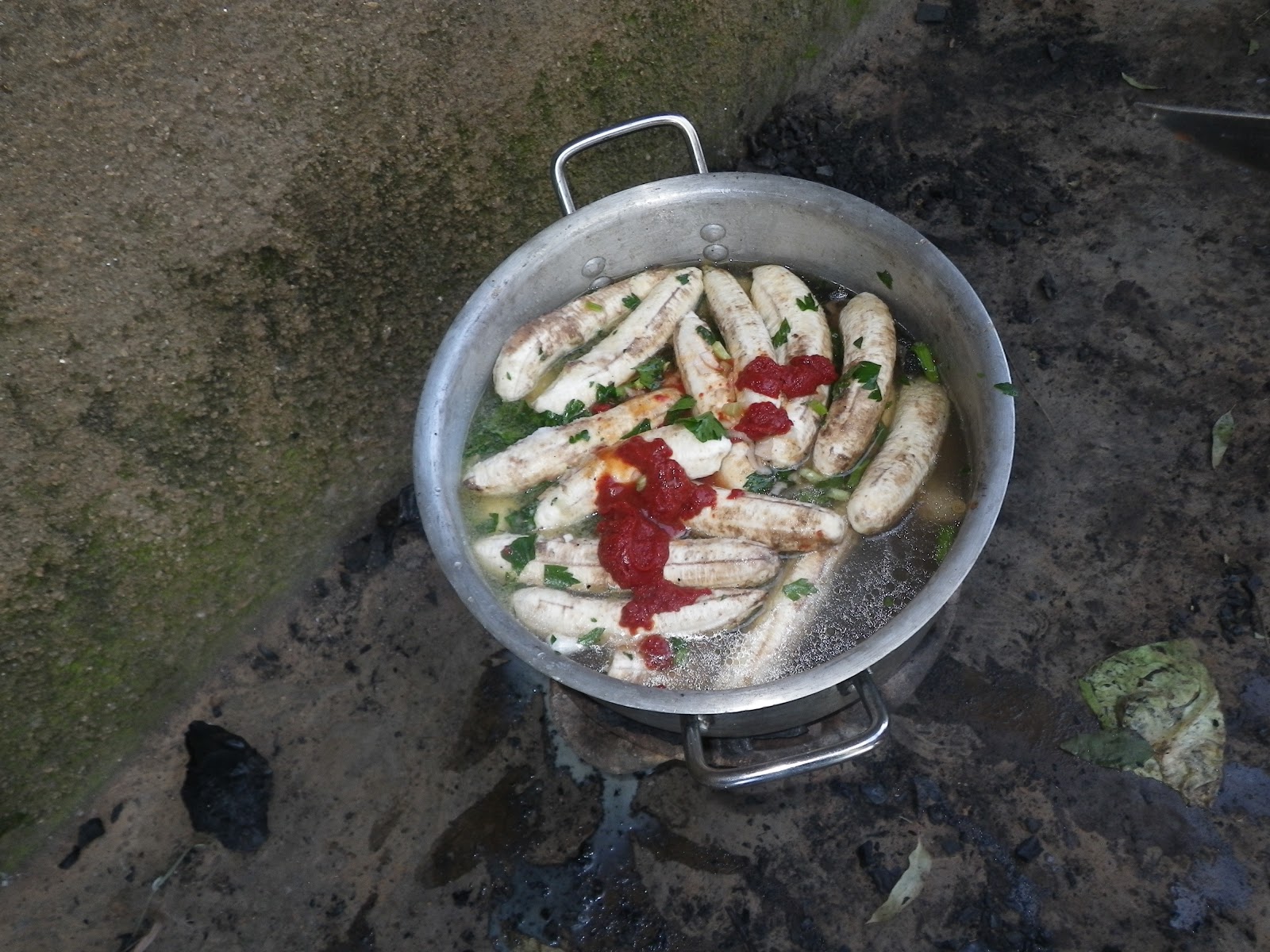
Agatogo, referred to by Peace Corps Volunteers as “Hangover Stew”, is Rwanda’s version of a good, soul-food, diner-ish breakfast. This delicious meal will settle your stomach after no matter how rough a night. It includes boiled plantains, tomato paste, cow or goat insides, and a few spices.

First, boil the meat.

Next, add it to your uncooked plantains.


Boil the two together, along with celery, onions, and other herbs, if so inclined.


Once the plantains are soft, add at least two cans of tomato paste to your stew.


Let it simmer over the fire for at least another half hour.

Cool it down and… muryohergwe, enjoy!


Friday, September 21, 2012

KITTY

Friends and family: meet Kitty, the newest addition to my life in Rwanda. 

Kitty came to me by way of my counterpart, who has a cat, who had a litter of three kitties. Kitty enjoys drinking milk, eating food that I am about to put in my mouth, chasing salamanders, killing mice (which makes her beloved among my neighbors), and best of all...cuddling. I could not be happier!


Monday, September 10, 2012

Talk ain't cheap


During BE Camp I taught a 90 minute lesson on communication skills. As I’ve mentioned before, I am a strong believer in direct communication. Rwandan culture disagrees with me. Nevertheless, I prevail.

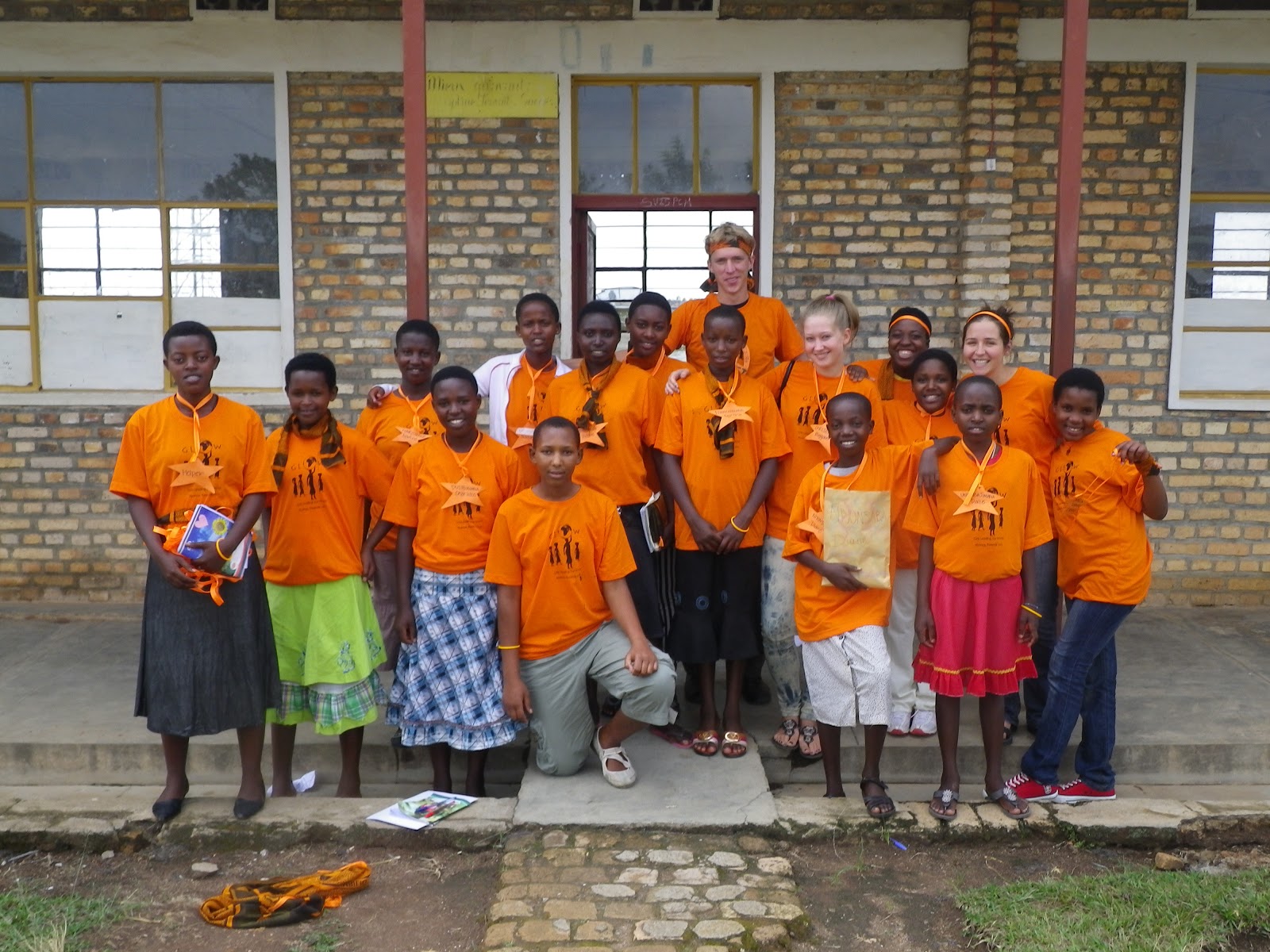
Girls from my community who came to Camp GLOW
I began each lesson (students rotated through four lessons each day, so I taught the same lesson to four different groups of thirteen students) with the telephone game. I whispered something silly into the ear of the boy next to me, who repeated it to the boy next to him, and so on until the last student said aloud what he heard. “The elephant wears purple shoes” turned into “I love you”. Obviously, good communication is important!

Next, I instructed each student to draw one picture of themselves with power, and one without power. When volunteers came forward to explain their drawings and talk about how each position made them feel, I was overwhelmed by the answers, so indicative of Rwandan culture. Almost every student drew a picture of a man in a suit, often with a briefcase, a nice house, and a car. “When you have power, you have money, and all things are possible.” Nearly all the students who shared their interpretations of no power had drawn themselves as farmers, with a hoe in hand and dirty clothes. “When you are poor you have no power.”

I then asked the students if they behaved and spoke differently to people with power. The question received overwhelming affirmative answers. To drive the point home, I asked: “What would you do if a primary school student took your ball away? What would you say to him to get it back?” “We would beat him!” was the most common answer. “Now, imagine the headmaster took your ball away, what would you do to get it back? What would you say?” Most of the students agreed they wouldn’t even bother asking for it.

Together, the students made a long list of behaviors that were aggressive and another of behaviors that were passive. Aggressive behaviors can hurt the person you are talking to, and passive behaviors can hurt yourself. How can we communicate without hurting?

Defining assertive was tricky for several reasons. The lesson was conducted mostly in Kinyarwanda. During the training of trainers, my Rwandan co-facilitator listed many words in Kinyarwanda that he interpreted as assertive, given my English explanation. Several of the words he suggested had connotations I knew were in fact negative. As I’ve mentioned before, in Rwandan to have good culture often involves shutting up. (For example, even in professional settings, many professional Rwandans will whisper when talking to a superior, because traditionally it is considered a sign of disrespect to speak or otherwise act in a way that is equal to your superior.) However, through careful and lengthy explanations we got the point across and agreed on culturally appropriate and effective ways to assert ourselves. My new favorite Kinyarwanda word: kumvicana, to understand each other.
Making clay cell phones during arts & crafts

I was very pleased with the students’ participation and the list of assertive actions they came up with. The most telling part of the lesson, of course, was the final application section in which students acted out scenarios. In one class, I started by taking a pen from a student. Thierry, one of the brightest and most engaged students, looked confused.

“I took your pen Thierry, what are you going to do?” I asked.

Bashfully, he responded, “It’s ok, I have another pen.”

Well, ok, we’ve identified passive behavior. “Let’s try again, Thierry. Come forward. I took your pen! How can you ask for it back? What can you say?”

“Okay, teacher” he came forward reluctantly. “If you have taken my pen… I guess I will come to you and tell you that you are my friend, and up until now we have had no problems. I can tell you that I am your friend, and you can always talk to me and ask me for advice if you have problems“.

The passive format was all too similar to so many of the conversations I hear in Rwanda, which lead to so many of the conflicts I witness, and why I believe so strongly that teaching assertive communication is absolutely essential. So again, the class reviewed characteristics of assertive behavior and communication. 

“Let’s try again, Thierry. I took your pen, ask for it back assertively.”

“Hi Alma, can I please have my pen back?”

“Yes, Thierry, you can!” 

Sunday, September 9, 2012

Southern Province GLOW & BE Camps


During the month of August I had the pleasure of participating in this season’s GLOW (Girls Leading Our World) & BE (Boys Excelling) Camps. Last November, I organized GLOW & BE Camps for my district and enjoyed them immensely. Running the camps was a fantastic experience and I learned a lot from working with Rwandan officials and coordinating logistics, but I missed the opportunity to really get to know the students and participate in many of the fun camp activities. So, when volunteers began planning for summer camps I volunteered to be a camp facilitator instead of administrator, and I had a blast.

Playing an ice-breaker during Camp BE
The goal for GLOW & BE Camps across Rwanda (and most countries where Peace Corps Volunteers put on camps) is to teach valuable life skills that will empower youth to make good decisions, think about their future, their health, and gender equality. In Rwanda, GLOW & BE Camps are funded by the President’s Emergency Plan for AIDS Relief (PEPFAR), an initiative aimed at addressing the global HIV/AIDS pandemic; so the camps also focus on teaching campers about HIV/AIDS. Camps include a two day Training-of-Trainers for PCVs, community counterparts, and students who have previously completed the camps. After facilitators have been trained on the general camp philosophy, week activities, and lessons, the campers arrive for four to five days of nonstop action. The days are consumed by ice breakers, cheers, life skills lessons, guest speakers, and other camp activities like making s’mores.

I am certainly not a camp person, and while I did sing “Boom-Chica-Boom” around the camp fire, I won’t be sad if I never have to do it again. Truth be told, I really hope I never hear that song again.

My favorite parts of camps were the lessons. I learned just as much if not more than the students while teaching communication skills, leadership styles, and healthy relationships. My primary duties at post involve working with adults, who are often less eager to learn new things and generally more comfortable in their established routines. With students, the excitement is palpable and invigorating. The two weeks I spent at the camps reminded me why I joined Peace Corps in the first place and really made me feel like my work here means something.

With my "Hero Group" at Camp GLOW
Several district and regional camps were conducted across Rwanda during the months of July and August.  Since Peace Corps came to Rwanda in 2009, four rounds of camps have been conducted. This group was the second done at the regional and district level. It gave me great pleasure to witness how much improvement is being made, how many good practices from previous camps have been kept and how many lessons have been learned. The challenges involved in pioneering a project are many, but the rewards are great.   

Sunday, August 19, 2012

Having fun in Huye

Huye's Post Office
The nearest "big city" to my site is Huye. Huye (formerly and sometimes still known as Butare) is Rwanda's second largest city, and home to the National University of Rwanda, NUR. In Huye you can also find soft serve ice cream, the National Museum of Rwanda, my often lonely postal box (hint, hint), some banks, and a couple not-so-great-but-passable-after-several-weeks-in-village western restaurants.

If you're planning a trip to Rwanda and are short on time, Huye is a city you can skip. Visit the gorillas in the Virunga Volcanoes, the monkeys and cimpanzees in Nyungwe National Forrest, relax on the lake in the calm 'city' of Kibuye/Karongi, or enjoy yourself in the slightly livelier town of Gisenyi/Rubavu. In case you happen to find yourself in Huye, here are some notes to help you around:

Orientation
Huye is located in Southern Rwanda. The city is about a two hour easy car ride south of Kigali, about two and a half or three hours east of Nyungwe National Forrest, and about 130 kilometers from Bujumbura, Burundi. 

The residential areas of the city are spread out, but the center city is rather small and easy to get around. If you are coming north from Kigali, the first thing you will see is the National Museum of Rwanda before entering town. Once you're in town you'll notice the main road continues south towards the University (and eventually Bujumbura). The other road to notice intersects and leads you towards the market (west) or the cathedral (east).
Huye Market

Lodging
Huye has a range of hotels that vary drastically in price and services. If you want to go dirt-cheap I recommend Procure Guest House. It's located just a few steps from the cathedral and is run by nuns. A single bed can run you as cheap as 2,000 RWF (around $3) per night. For this price, you will be escorted to a large building that has been split up into cubicle-style rooms with single beds, separated by very thin wooden sheets (I wouldn't go so far as to call them walls). The bathrooms and cold showers are communal. I recommend earplugs. 

For a bit more comfort and less noise, I'd recommend Beaux Arts Guest House, which is located just before the main market. Here you can get a double room for 7,000 RWF (around $12) with a private bathroom, still no hot water. 

If your wallet is padded, I'd recommend Barthos Hotel, located right next to the National University, or Hotel Ibis, smack in the middle of town. The cheaper rooms in these hotels run around 16,000 RWF (around $27). Ibis is very centrally located and has been around forever, Barthos is nice and has good food.
Inside Hotel Ibis

Food
Most bars and restaurants in Rwanda are painted blue on the outside
The food in Huye is nothing to write home about. For western style food you can visit Ibis Hotel (the food is overpriced and passable at best, however the atmosphere is generally calm and the outdoor patio is great for a relaxing, overpriced beer), or Cheers (located across the street from Ibis, slightly less overpriced and slightly more passable food). There is also a Chinese restaurant called "Chinese Restaurant" (behind the gas station next to the market) that is sometimes open, and sometimes serves delicious noodles that arrive two hours after you've placed your order. 

For local food I recommend Barthos Hotel (the chicken is delicious), Gracia Resto/Bar (a few steps down from the Chinese Restaurant, also serves delicious chicken and is a popular among University students), or what I like to call "the jungle restaurant" (on the right side of the road when you're heading south towards the University, you'll recognize it for the numerous plants on the sides): a local buffet restaurant that's always packed and has the very best chapati bread I've had in Rwanda for only 100 francs ($0.17). 

As I mentioned, Huye is also home to Rwanda's soft-serve ice cream shop Inzozi Nziza. The shop (located on the main road south, just before the University) opened a few years ago with the assistance of Blue Marble Dreams, an ice cream shop in Brooklyn, New York. Inzozi Nziza (which means "sweet dreams" in Kinyarwanda, although Rwandans seldom use this expression) has been featured in Oprah Magazine and received lots of international press, which makes the shop very popular among Western visitors (I rarely see Rwandans here). The ice cream is good when you haven't had ice cream in a long time. I would caution visitors against the sandwiches and coffee. For coffee, visit the locally started Coffee Connection shop on the same road as Inzozi Nziza, a bit further up. The service is incredibly friendly, the coffee is good and very cheap (less than a dollar for a cappuccino!). 

Entertainment
There's not too much to do in Huye town. As I mentioned, the National Museum of Rwanda is located near the northern entrance to the city. I haven't been inside the museum, but the landscape around it is beautiful and a popular place for Rwandans to take wedding pictures-- so if you're visiting on a Saturday (particularly during the month of August) expect to see large parties in the gardens. Fellow volunteers who have taken visiting family members have always had positive things to say about the museum. 
National University of Rwanda campus
I recommend taking some time to stroll around the National University of Rwanda's campus and potentially catching a glimpse of some of the monkeys that roam around (I often wonder if NUR students visiting Cornell would be as shocked by squirrels as I am by the monkeys). There are security guards at all entrances to the University who ask for identification before entering, however, I have never been stopped. 

with friends at the NUR graduation

Being a college town, Huye has a bit of nightlife, although not much. Hotel Faucon (the first building on the main street when you are coming into Huye from the north) has a nightclub inside which requires what I consider to be a ridiculous cover charge (generally $2) but the music is sometimes fun and as a female, I appreciate that very few creepers that are allowed in. There used to be a night club behind Cheers restaurant called Space Place, but it was recently closed. I hear rumors of a fun University Club close to campus, but I haven't been there personally. 


On a hot day, I'd recommend grabbing an ice cream at Inzozi Nziza and crossing the street over to Credo Hotel to hang out at the pool. Warning: if you are a single or group of young women, expect a lot of attention and chest beating from young men here-- mostly in the form of these guests doing push ups and sit ups in front of you while wearing boxer briefs. Despite this awkward distraction, the pool is relaxing. 


A few weeks ago, some friends and I decided to walk from my site to Huye. The drive takes less than an hour in a private vehicle, two hours on the bus, and took us two days walking. It was a lot of fun and a great way to enjoy the beautiful scenery without being squeezed in a bus.


After two days of walking, we finally hit tarmac! 

To conclude, my favorite piece of American influence on the intellectual city of Huye...